


Beginnings and blacksmithing
In 1953, at the age of 14, Yvon Chouinard, founder of Patagonia, began climbing with the Southern California Falconry Club. This club trained falcons for hunting. After one of the adult leaders, Don Prentice, taught the boys how to rappel down cliffs to reach falcon nests, Yvon and his friends enjoyed the sport so much that they began jumping freight trains west of the San Fernando Valley and sandstone cliffs at Stoney Point. There, they learned to climb and rappel.
Chouinard began spending every winter weekend at Stoney Point and every spring and fall at Tahquitz Rock, north of Palm Springs. There he met other young climbers who belonged to the Sierra Club, including T.M. Herbert, Royal Robbins, and Tom Frost. Later, the friends moved from Tahquitz to Yosemite to learn how to climb the big walls.
The only pitons available at the time were made of soft iron, and once placed in the rock, they stayed put. But in Yosemite, the multiple climbs each day required hundreds of placements. After meeting John Salathé, a Swiss climber and mystical Swedenborgian who had once made hard iron pitons from Model A axles, Chouinard decided to make his own reusable gear. In 1957, he went to a junkyard and bought a coal forge, a 140-pound anvil, and some tongs and hammers, and began teaching himself blacksmithing.
Chouinard made his first pitons from the blade of an old combine harvester and tested them with T.M. Herbert on the first ascents of Lost Arrow Chimney and on the north face of Sentinel Rock in Yosemite. Word got around, and soon his friends wanted Chouinard's chrome-plated steel and molybdenum pitons. Before he knew it, he was in business. He could forge two pitons an hour and sold them for $1.50 each.
Chouinard built a small business in his parents' backyard in Burbank. Because most of his tools were portable, he could load them into his car and travel the California coast surfing, from Big Sur to San Diego. After a session, he would drag his anvil to the beach and cut angles of pitons with a cold chisel and hammer before moving on.
In the following years, Chouinard melted pythons during the winter months, spending April through July on the walls of Yosemite and then escaping the summer heat to the high mountains of Wyoming, Canada, or the Alps, before returning to Yosemite in the fall until the first snowfall in November. He eked out a living selling equipment from the trunk of his car. However, his income was meager. At times, he lived for weeks on fifty cents to a dollar a day. One summer, before heading to the Rockies, he bought two dented cans of tuna cat food at a San Francisco outlet store. These food supplies were supplemented with oatmeal, potatoes, and boiled squirrels and porcupines.
In Yosemite, Chouinard and his friends were known as "The Valley Army." They had to hide from the rangers on the rocks north of Camp 4 when they exceeded the two-week camping limit. They were proud that climbing rocks and frozen waterfalls was free, and that they were rebellious. Their heroes were Muir, Thoreau, Emerson, Gaston Rebuffat, Richard Cassin, and Herman Buhl.
Chouinard's team
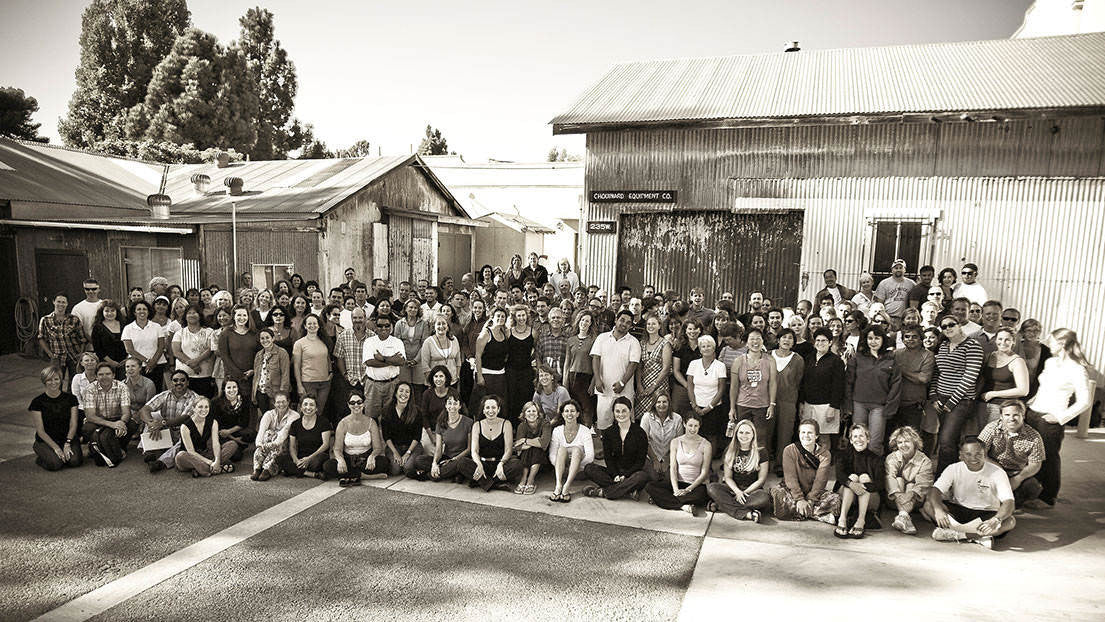
The demand for Chouinard's equipment soon increased, and he could no longer manufacture it by hand. He had to start using tools, dies, and machinery. In 1965, he partnered with Tom Frost, an aeronautical engineer and mountaineer with a keen eye for design and aesthetics. During the nine years Frost and Chouinard were partners, they redesigned and improved nearly every piece of climbing equipment. They made them stronger, lighter, simpler, and more functional. They returned from each trip to the mountains with new ideas for improving existing tools.
The guiding principle for his designs came from the French aviator Antoine de Saint Exupéry:
Have you ever thought that not only in the airplane, but in everything that man creates, all of man's industrial efforts, all his computations and calculations, all the nights he spends working on sketches and projects, invariably culminate in the production of something whose guiding and unique principle is the ultimate principle of simplicity?
It is as if there were a natural law that dictates that to achieve this end, to refine the curve of a piece of furniture, the keel of a ship, or the fuselage of an airplane, until it gradually becomes part of the elemental purity of the curve of the human breast or shoulder, there must be generations of artisans experimenting. In everything, perfection is ultimately achieved not when there is nothing left to add, but when there is nothing left to take away, when a body has been stripped to its nakedness.*
In 1970, Chouinard Equipment was the largest supplier of climbing equipment in the United States. It was also an enemy of the environment, because its equipment damaged the rock. Climbing had become more popular, but it remained concentrated on well-trodden routes in areas like Golden Canyon, the Shawangunks, and Yosemite Valley.
The same fragile cracks had to withstand repeated hammering of pitons during placement and removal, and the deformation was severe. After an ascent of the degraded Nose Route on El Capitan, which had been pristine just a few summers before, Chouinard and Frost decided to abandon the piton business. This would be the first major step we would take for the environment over the years. It was a huge business risk—pitons were still the mainstay of the business—but we had to do it.
Fortunately, there was an alternative: aluminum anchors that could be hand-fitted instead of being forced in and out of the cracks. We introduced them in the first Chouinard equipment catalog in 1972.
The catalog began with an editorial from the owners about the dangers of pitons to the environment. The 14-page essay written by climber Doug Robinson on how to use camming devices began with a powerful paragraph:
There's a word for this, and that word is clean. Climbing with only nuts and ropes for protection is clean mountaineering. It's clean because the climber doesn't destroy the rock in their wake. It's clean because nothing is hammered into the rock only to be removed later, leaving a mark and making the next climber's experience less natural. It's clean because the climber's protection leaves few traces of their ascent. Clean climbing is climbing the rock without altering it, a step closer to organic mountaineering for the natural man.
A few months after the catalog had been mailed, the piton business had stalled, and the anchors were selling faster than they could be manufactured. In the Chouinard Equipment sheds, the rhythmic pounding of the forging hammer gave way to the sharp squeal of drills.
Clothing for climbers
In the late 1960s, men didn't wear bright, colorful clothes, not outside their homes. Athletic wear consisted of gray tracksuits and pants, and for climbing in Yosemite, they wore cut-off tan cotton pants and white dress shirts bought at flea markets. On a mountaineering trip in Scotland in 1970, Chouinard bought a regulation rugby jersey to wear while climbing. Designed to withstand the rigors of rugby, it had a collar that would prevent team tapes from cutting into his neck. It was blue, with two red stripes and a yellow one down the center across the chest. When he returned to the United States, Chouinard wore it with his climbing friends, who asked him where they could get one.
We ordered a few T-shirts from Umbro in England, and they sold out immediately. We couldn't keep them in stock, and soon we were also ordering T-shirts from New Zealand and Argentina. Other companies copied us, and we quickly realized we had introduced the latest fashion trend to the United States. We began to think of apparel as a way to help sustain the marginally profitable team business, and by 1972 we were selling polyurethane raincoats and bivouac sacks from Scotland, wool gloves and mittens from Austria, and reversible hand-knitted hats from Boulder.
As we produced more and more clothing, we needed a name for our apparel line. Why not “Chouinard”? We already had a good brand image, so why start from scratch? We had two reasons against this. First, we didn't want to weaken Chouinard's image as a tool company by making clothing under that name. Second, we didn't want our clothing to be associated solely with mountaineering.
For most people, especially back then, Patagonia was a name like Timbuktu or Shangri-La: distant, intriguing, not quite on the map. Patagonia brings to mind, as we once wrote in a catalog introduction, “romantic visions of glaciers plunging into fjords, of steep, wind-eroded peaks, of gauchos and condors.” It has been a good name, and it can be pronounced in every language.
Capilene® and Synchilla®: a story of layers
At a time when the entire mountaineering community relied on traditional cotton and wool layers for moisture absorption, we looked elsewhere for inspiration and protection. We decided that the essential garment of North Atlantic fishermen, the synthetic fleece sweater, would be an ideal mountain layer, as it would insulate well without absorbing moisture.
But we needed to find some fabric to test our idea, and it wasn't easy to find. Finally, Malinda Chouinard had a hunch: she drove to the Merchandise Mart in Los Angeles and found what she was looking for at Malden Mills, which had just emerged from bankruptcy after the collapse of the faux fur coat market. We sewed samples and conducted field tests in alpine conditions. It had flaws: a thick, heavy fit and a hairy appearance on a bad day, due to the fibers quickly pilling. But it was amazingly warm, especially when worn with a shell. It insulated when wet, but also dried in minutes, reducing the number of layers a climber needed.
It's not a good idea to wear a quick-drying insulating layer over cotton underwear, as the cotton absorbs moisture from the body and then freezes. So, in 1980, we created insulating underwear made of polypropylene, a synthetic fiber with a very low specific weight that doesn't absorb water. It had previously been used in the manufacture of industrial products such as floating marine ropes. Its first adaptation for clothing was in a non-woven interlining for disposable diapers.
Utilizing the potential of this new underwear as the foundation of a system, we became the first company to introduce the concept of layering to the outdoor community through trials in our catalog. This approach involves using an inner layer next to the skin to wick away moisture, a mid-layer of fleece for insulation, and an outer shell layer for protection from wind and water.
It wasn't long before we saw much less cotton and wool in the mountains, and lots of light blue and tan fleece sweaters covered in little balls over striped polypropylene underwear.
Polypropylene, like pile, had some problems. It melted at very low temperatures, and customers were finding their underwear melting in commercial dryers, which dried at higher temperatures than home dryers.
Furthermore, because polypropylene is hydrophobic and repels water, it was difficult to wash thoroughly and retained odors. Its waterproof properties were not inherent to the fabric itself, but rather a result of the application of oils during the spinning and weaving process, and these properties disappeared after about twenty washes.
Although pile and polypropylene were an immediate success and had no significant competition yet, we worked hard from the beginning to improve our quality and overcome the problems of both fabrics.
The improvement of pile was a gradual process. With Malden, we worked closely to develop first a softer Bunting fabric, a boiled synthetic wool that pilled less, and eventually Synchilla®, an even softer, reversible fabric that didn't pill at all. With Synchilla, we learned an important business lesson. While Malden's capital enabled many of the innovations, the fabric would never have been developed if we hadn't actively shaped the research and development process. From that point on, we began making significant investments in research and design. Our laboratory and our fabric development department, in particular, became the envy of the industry. Spinning mills were eager to work with us on development projects. They knew that if Patagonia gave them a push or a helping hand, the resulting fabric would likely be better.
But our replacement with propylene did not emerge from a process of mutual development with a spinning mill; it came out of nowhere.
In 1984, while walking through the Sporting Goods show in Chicago, Chouinard saw grass stains being removed from polyester soccer jerseys. Polyester, like polypropylene, is made from molten plastic resins extruded through a die to create a fine, yarn-like fiber. These plastic fibers are very soft, and clothing woven from them is difficult to wash because the rubberized fibers repel soap and water during a normal wash.
Milliken, the football shirt factory, had developed a process that permanently etched the surface of the fiber during extrusion, making it hydrophilic (water-loving). It drew moisture away through capillary action, and the treatment was permanent. Chouinard considered the fabric perfect for underwear. And because polyester melts at a much higher temperature than polypropylene, it wouldn't melt in a commercial dryer.
In the fall of 1985, we switched our entire line of polypropylene underwear to the new polyester Capilene®. It was a big risk, similar to the introduction of the bolsters in 1972. In the same season, we also introduced the new Synchilla fleece: together, the old polypropylene and Bunting products accounted for 70% of our sales. But our loyal customers quickly discovered the advantages of Capilene and Synchilla, and sales soared.
Growth difficulties
In the early 1980s, we introduced another major change. At a time when all outdoor gear was tan, forest green, or, at most, light blue, we flooded the Patagonia line with vibrant colors. We introduced cobalt, teal, deep red, aloe, turquoise, and brown. Patagonia apparel remained rugged and went from looking dull to blasphemous.
The huge popularity of bold colors and the growing appeal of technical fabrics like Synchilla brought a new concern. The Patagonia label had become a fad like the rugby jersey, and our popularity extended far beyond the outdoor community, reaching fashion-conscious consumers. Although we devoted most of our sales efforts and catalog space to explaining the technical merits of layering to knowledgeable enthusiasts, and were successful with those products, our best-selling items were the least technical: baggy beach shorts and short Synchilla shell jackets.
We began to grow at a rapid pace and made it onto Inc. Magazine's list of fastest-growing private companies. That rapid growth stalled in 1991 when our sales slowed during a recession, and our banks, already struggling and on the verge of bankruptcy, canceled our revolving loan. To pay off the debt, we had to drastically cut costs and offload inventory. We laid off 20% of our workforce, many of them friends and friends of friends. And we nearly lost our independence as a company. That taught us an important lesson. From that point on, we kept growth and borrowing on a modest scale.
Let my people surf
In many ways, we were able to keep our cultural values alive, even during the years of rapid growth and after the shock of the 1991 layoffs. We were surrounded by friends who could dress however they wanted and even go barefoot. People would run or surf at lunchtime, or play volleyball in the back of the building. The company sponsored ski and tourism trips; there were groups of friends who would take informal trips, traveling to the mountains on a Friday night and arriving home a little shaky but happy, just in time for work on Monday morning.
Since 1984, we haven't had private offices. This architectural arrangement sometimes creates distractions, but it also keeps communication open. That year, we opened a cafeteria where employees can meet during the day, and which currently serves healthy, mostly vegetarian, food. Furthermore, at Malinda Chouinard's insistence, we opened a childcare center on our premises—at the time, one of only 150 in the country (today there are more than 3,000). The presence of children playing in the playground or having lunch with their parents in the cafeteria helps maintain a more family-oriented than business-like atmosphere in the company. We also continue to offer flexible working hours and job sharing, primarily for the benefit of working parents, but also for others.
We've never had to bow to the traditional corporate culture, which makes business rigid and stifles creativity. In general, we've simply made the effort to maintain our own values and traditions.
Beginnings of environmental ethics
Patagonia was still a fairly small company when we began dedicating time and money to the increasingly apparent environmental crisis. We all saw what was happening in the most remote places on the planet: growing pollution and deforestation, and the slow, then not-so-slow, disappearance of fish and wildlife. And we saw what was happening closer to home: thousands-of-years-old sequoias succumbing to Los Angeles smog, dwindling life in marshes and kelp forests, and uncontrolled land development along the coast.
What we read about global warming, the logging and burning of tropical forests, the rapid loss of groundwater and topsoil, acid rain, and the destruction of rivers and streams by damming them, reinforced what we saw with our own eyes and smelled with our noses when we traveled. At the same time, we became aware that significant results could be achieved through the arduous battles fought by dedicated small groups of people to save habitat areas.
We learned our first lesson right here at home, in the early 1970s. A group of us went to a City Council meeting to help protect a surf zone. We vaguely knew that the Ventura River had once been an important habitat for coho salmon. Then, in the 1940s, two dams were built, and the water was diverted. Except for winter rains, the only water left at the river mouth flowed from the wastewater treatment plant. At that City Council meeting, many experts testified that the river was dead and that channeling its mouth would have no effect on the remaining birds and wildlife or the surf zone.
The outlook was bleak until Mark Capelli, a 25-year-old biology student, showed a slideshow of photographs he had taken along the river: of birds living in the willows, muskrats and sea snakes, and eels spawning in the estuary. He even showed a slide of a golden trout. Approximately fifty golden trout were still spawning in our dead river.
The development plan was defeated. We gave Mark office space, a mailbox, and small contributions to help him win the battle for the river. More development plans emerged, and the Friends of the Ventura River worked to defend it, clean the water, and increase its flow. Wildlife increased, and more coho salmon began to spawn.
Mark taught us two important lessons: that grassroots efforts could make a difference, and that degraded habitats could, with effort, be restored. His work inspired us. We began making regular donations and joining small working groups to save or restore habitats instead of donating money to NGOs with large staffs, overhead, and corporate connections. In 1986, we pledged to donate 10% of our annual profits to these groups. We then raised the stakes to 1% of our sales, or 10% of our profits, whichever was greater. Since then, we have maintained that commitment every year.
In 1988, we launched our first environmental campaign in support of an alternative master plan to de-urbanize Yosemite Valley. Every year since then, we have conducted a major environmental education campaign. We were pioneers in taking a stand against the globalization of trade when it compromises environmental and labor standards. We advocate for the removal of dams that dam rivers. Marginal utility dams compromise fish populations. We support wilderness projects that seek to preserve entire ecosystems and create corridors for wildlife to roam. Every eighteen months, we host a conference called “Tools for Activists,” where we teach marketing and publicity to some of the groups we work with.
Also, from the beginning, we took initial steps to reduce our own role as a polluting company: since the mid-1980s, we have used paper with recycled content for our catalogs. We worked with Malden Mills to develop recycled polyester for use in the manufacture of Synchilla fleece.
Our distribution center in Reno, which opened in 1996, achieved a 60% reduction in energy consumption through the use of solar-tracking skylights and radiant heating. We used recycled materials for everything from rods and carpeting to urinal partitions. We modernized the lighting systems in existing stores, and new store construction became increasingly environmentally friendly. We evaluated the dyes we used and removed colors that required toxic metals and sulfides from our product line. Most importantly, since the early 1990s, environmental responsibility has been a core value for everyone.
Our switch to organic cotton
When we commissioned an independent research firm to conduct an environmental impact assessment of our four main fibers, we expected oil-based polyester and nylon to be major energy consumers and sources of pollution. And they were, but not as much as cotton.
The natural fiber used in most of our sportswear proved to be by far the biggest environmental culprit of all the fibers studied. We discovered that 25% of all toxic pesticides used in agriculture were (and are) used on cotton cultivation, that the resulting soil and water pollution was (and is) appalling, and that the evidence of harm to the health of farmworkers is strong, though difficult to prove.
Cotton was the main villain, and it shouldn't have been. Farmers had grown cotton organically without pesticides for thousands of years. But after World War II, chemicals originally developed as nerve gases became available for commercial use, and it was no longer necessary to weed the fields by hand.
We decided to experiment. At first, we only made organic cotton T-shirts. Then, after several trips to the San Joaquin Valley where we smelled the selenium ponds and saw the lunar landscape of the cotton fields, we asked ourselves a critical question: How could we continue making products that devastated the Earth in this way?
In the summer of 1994 we decided that in 1996 all our cotton sportswear would be 100% organic.
We had eighteen months to make the switch across 66 products, and only four months to prepare the fabric. We found that there wasn't enough organic cotton available on the market to buy from intermediaries. We had to go directly to the few farmers who had returned to organic methods. And then we had to go to the gins and spinning mills and persuade them to clean their equipment after using it with what they would consider very small quantities. We spoke with certifiers to ensure the fiber's journey was traceable all the way to the bale.
We succeeded. Since 1996, every cotton garment from Patagonia has been organic, and it has been ever since.
Next steps
We continue our search for environmentally friendly fabrics. We're using more hemp in some products, blended with recycled polyester. Recently, one of our suppliers discovered how to recycle polyester from sources other than soda bottles, and we're using the resulting fabric in some of our best-selling products. More importantly, the garments themselves can potentially be recycled. In the future, it should be possible for consumers to return a polyester jacket to us for processing and remaking into fiber or other forms of plastic.
Thirty years after the first Patagonia label appeared, we continue to make the best product. The pace of innovation over the last five years has been one of the most significant. We developed Capilene® layers of different knit fabrics designed to fit the body. Through their careful construction, these layers wick away moisture more efficiently and allow for greater freedom of movement.
Regulator® insulation represents a significant technical improvement over Synchilla. It's lighter, warmer, wicks moisture faster, and is much more compressible into a pack. And it works in conjunction with an amazing new generation of layers—hard, soft, and hybrid—that are also lighter, more elastic, and more flexible than any of their predecessors.
In fact, fabrics have advanced so far in the direction of St. Exupéry's functional minimalism that methods once limited to needle and thread now need updating. In the spring of 2005, we will introduce new sewing methods for soft and stiff fabrics that reduce bulk, improve drape, and, most importantly, enhance performance in wet weather.
Over the past 30 years, we've made many mistakes, but we've never strayed far from our path. Although our initial intention was for Patagonia to be a way to escape the limitations of our original climbing business, it was precisely those limitations that kept us sharp and helped us thrive. We still enjoy mountaineering and surfing, activities that involve taking risks, having a spirit, and inviting reflection. We favor informal trips with friends, doing what we love, and filming events. We cannot afford to knowingly produce a mediocre product or turn a blind eye to the damage we've all done to our one and only home.
* Excerpts from The Wind, the Sand and the Stars. Copyright 1939 by Antoine de Saint-Exupéry, renewed in 1967 by Lewis Galantière, reprinted with permission of Harcourt, Inc. This material may not be reproduced, stored in a retrieval system, or transmitted in any form or by any means without the prior written permission of the publisher.
Patagonia
Más sobre Patagonia
